Environmental Engineering Student Uses Global Co-Op to Protect Coastal Groundwater in Australia
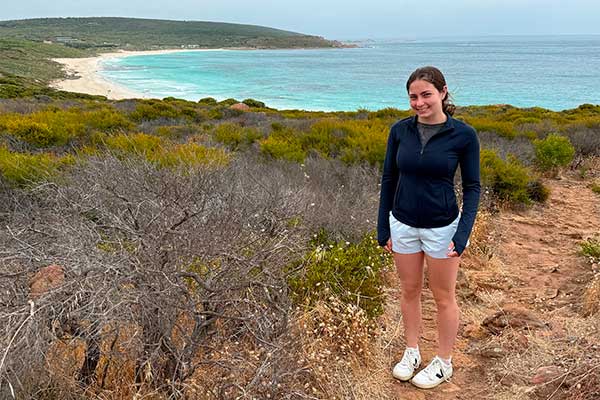
During her co-op at the University of Western Australia, Emma Collins, E, environmental engineering, analyzed decades of environmental data to help protect coastal groundwater systems from climate change.
This article originally appeared on Northeastern Global News. It was published by Matthew Ponsford. Main photo: Emma Collins had the chance to deepen her connection with her extended family, while becoming the co-author of a scientific study. Courtesy of Emma Collins
She returned to family roots for a chance to reveal a changing planet
Northeastern student Emma Collins is set to co-author a study on the coastal environment near Perth, combining data science with field research to help protect crucial groundwater reserves.
Northeastern University student Emma Collins had always known Australia’s West Coast as a place for family vacations, where her mother and father held their warmest childhood memories.
“My parents were both born and grew up there,” she said. “My mama would always say: ‘The blue sky is different here’ or ‘the beaches are different.’”
Growing up, Collins didn’t get why her parents felt the coast around the city of Perth was so special, she said. But having just spent a semester there conducting fieldwork during a co-op placement at the University of Western Australia (UWA), she could see its value.
Since January, Collins has been part of a research project that is revealing how climate shifts are changing the coastal wetlands of the Swan Coastal Plain and how groundwater systems are responding to climate change. Bringing data analysis skills from her degree in environmental engineering and data science at Northeastern’s Boston campus, Collins found a new purpose for her data skills in outdoor research that has made her reconsider her future plans and set her sights on a Ph.D. in research, following in the footsteps of her mother and grandfather, who taught at UWA.
Having the opportunity to combine meaningful research, international experience and personal connections made it truly an amazing opportunity, Collins said. “I was able to spend six months getting to know my family while gaining international research experience.”
New outlook
Moving to Western Australia in January was a dramatic change of scenery from Boston. Western Australia has a Mediterranean climate with distinct wet and dry seasons, “which is very different from the northeastern United States,” she explained. Seeing how those differences affect the vegetation and ecosystems “gave me a new appreciation for how environmental engineering challenges vary around the world,” she said.
Read full story at Northeastern Global News